
Fingerprint hardware is one of those categories where the sensor itself is rarely the problem. If you have been comparing options for a desktop biometric login or a point-of-sale check-in system, the DigitalPersona U.are.U 4500 shows up constantly in enterprise deployments, school attendance setups, and clinic sign-in stations.
This Digital Persona U.are.U 4500 Reader review looks at what you get for the money: a 512 dpi optical sensor in a weighted metal shell, a long USB cable, and absolutely nothing else in the box. No CD, no drivers, and no manual ship with this unit, so budget setup time for sourcing an SDK or a Linux driver before you deploy it.
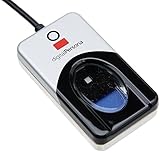
- Target Applications - Desktop PC security, Mobile PCs, Custom applications
- Indoor, home and office use
- Blue LED - soft, cool blue glow fits into any environment; doesn't compete in low light environments

The hardware itself earns its reputation. Optical scanning handles worn, dry, and callused fingers better than most capacitive sensors in this price bracket. The metal housing also stays planted on a desk while someone presses down on it.
Bottom Line
If you are comfortable installing your own drivers or integrating with an SDK, this is a durable, accurate sensor that has held up in production environments for years. Check current availability for the U.are.U 4500 on Amazon.
DigitalPersona U.are.U 4500 Reader Overview
Model 88003-001 is the standard-issue U.are.U reader you will find behind pharmacy counters and payroll terminals across the country. It weighs roughly 3.2 ounces, measures about 65 x 36 x 15.5 mm, and ships with a long USB cable that reaches from a floor-mounted tower to a countertop.
The sensor pairs with the DigitalPersona Identity Engine, which is where the matching accuracy comes from. Target uses run from desktop PC security to custom in-house applications.
Keep in mind this is an indoor device. There is no environmental sealing, so outdoor kiosks or dusty warehouse floors call for a different class of fingerprint reader.
Optical Fingerprint Scanning Accuracy
Optical capture is the reason this reader keeps getting specified into enterprise projects. The sensor resolves at 512 dpi across an 8-bit grayscale range (256 levels), giving matching algorithms far more ridge detail to work with than a compressed binary image.
The scan window measures roughly 14.6 mm wide by 18.1 mm long, which is enough to capture a full core and delta on most adult fingers if the user rolls slightly.
Where optical shines is on problem prints. Dry winter fingers, light scarring, and worn fingertips from manual labor read reliably here. Those are situations where cheap capacitive pads can fail repeatedly.
Compact Metal Housing and Blue LED
Build quality separates this from plastic consumer scanners. The casing is metal and deliberately weighted, so pressing a finger down does not slide the unit across the desk. It’s a small detail, but it matters when dozens of people use the reader daily.
The footprint is small enough to tuck beside a keyboard without crowding a mouse pad.
A soft blue LED marks the active scan area. It glows enough to guide a finger in a dim reception area without becoming a distraction in a dark room, unlike the harsh indicator lights found on some USB fingerprint reader models.
USB Connectivity and Software Compatibility
Connection is plain USB, compatible with USB 1.0, 1.1, and 2.0 Full Speed specifications. Any standard Type-A port supplies enough power, and the generous cable length means you rarely need a USB powered hub to reach a workstation.
Software is where buyers get caught off guard. Nothing is included, so Windows users need the DigitalPersona RTE or an SDK, often obtained through a reseller or a licensed integration partner.
Linux users have an easier path. The device is supported by libfprint, and users report successful setups on Mint, Kubuntu, and current Ubuntu releases with local accounts.
Pros and Cons
Pros
- Accurate optical sensing at 512 dpi that reads difficult, dry, or worn fingerprints
- Rugged metal housing with weighted base that resists sliding during use
- Long USB cable reaching roughly 70 inches for flexible desk placement
- Linux support via libfprint, confirmed working on Mint, Kubuntu, and Ubuntu
- Small footprint that fits beside a keyboard without crowding the workspace
- Widely deployed in commercial systems, so integration documentation exists
Cons
- No software, drivers, CD, or manual included with the device
- Windows Hello support is limited, with local accounts working more consistently than Microsoft accounts
- Driver sourcing takes effort, sometimes requiring contact with a reseller
- Indoor use only, with no dust or moisture protection
- Premium pricing compared to basic consumer USB fingerprint scanner options
- Occasional reports of failure after roughly a year of heavy use
Customer Reviews and Real-World Reliability
Feedback splits cleanly along one line: buyers who expected a plug-and-play consumer gadget versus buyers who knew they were purchasing an OEM component. The hardware itself draws consistent praise for accuracy and build.
Several reviewers deployed it in food service and attendance tracking systems, running custom software against thousands of daily scans without complaint. Linux users are especially positive, since working fingerprint hardware on Ubuntu and Mint is scarce.
The complaints are almost entirely about the missing software. Multiple buyers spent hours hunting for drivers, and a few requested refunds after failing to get it recognized in Windows.
A smaller thread mentions enrollment degrading over time or units failing after about a year. Compared to the Verifi P2000 USB fingerprint reader, which targets home Windows Hello users directly, the 4500 assumes you bring your own stack.
Conclusion
Buy this reader if you are building or maintaining a system, not if you want fingerprint login on a home PC by dinnertime. Developers, integrators, and IT staff supporting attendance or POS platforms get a proven sensor with documented SDK support and years of field deployment behind it.
Linux users running Mint or Ubuntu have a genuinely straightforward path through libfprint, which is rare in this category.
Before ordering, confirm your software stack. Identify the SDK or driver package you will use, and verify licensing terms with the vendor if the deployment is commercial. Skipping that step is what produces the frustrated one-star reviews.
Frequently Asked Questions
Does the DigitalPersona U.are.U 4500 include software or drivers?
No. Amazon listings for this model ship the reader and cable only, with no CD, drivers, or printed manual. You need to source the DigitalPersona RTE, an SDK, or an open-source driver separately before the device will do anything useful.
Does the DigitalPersona U.are.U 4500 work with Windows 11?
Yes, users have it running on Windows 11 with the appropriate driver package installed. Windows Hello integration is inconsistent, though. Local accounts work more reliably than Microsoft accounts, and some users never see Hello offer fingerprint as a sign-in option.
Can the DigitalPersona U.are.U 4500 be used with Ubuntu or Linux?
Yes, and this is one of its strongest use cases. The reader is supported by libfprint, with confirmed working setups on Ubuntu, Linux Mint, and Kubuntu. Disable auto-login first if you want fingerprint authentication at the login screen.
Is the U.are.U 4500 fingerprint reader suitable for custom applications?
Yes. Companies building attendance systems, cafeteria meal tracking, and point-of-sale identity checks use this exact model with custom software. The DigitalPersona SDK exposes the capture and matching functions needed for that kind of integration.
How accurate is the DigitalPersona U.are.U 4500 fingerprint scanner?
It captures at 512 dpi with 256 grayscale levels, giving matching algorithms plenty of ridge detail to work with. Paired with the DigitalPersona Identity Engine, it can read difficult prints, including dry, scarred, or heavily worn fingertips, more reliably than typical capacitive consumer sensors.
TechBytes

Our mission is to showcase the complex world of technology with comprehensive, accessible reviews. We bring you the freshest insights on everything from the most streamlined smartphones to the mightiest laptops, as well as the latest in smart home gadgets that simplify your daily routine and fitness wearables that monitor your well-being. Rest assured, we're here to guide you through the ever-evolving tech landscape.
