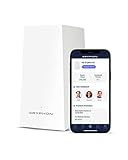
Dead spots behind the garage, buffering in the upstairs bedroom, and a router that needs a weekly reboot are the usual reasons people start shopping for mesh. The TP-Link Deco S4 two-pack targets exactly that problem without asking you to spend Wi-Fi 7 money.
This TP-Link Deco S4 mesh WiFi system review looks at a dual-band AC1900 kit that blankets up to 3,800 square feet with one network name, four gigabit Ethernet ports across the two units, and app-driven setup that takes most people well under an hour.

- A New Way to WiFi: Deco Mesh technology gives you a better WiFi experience in all directions with faster WiFi speeds and strong WiFi signal to cover your whole home.
- AC1900 Dual-Band Wi-Fi 5 Speeds: Delivers up to 1300 Mbps on the 5 GHz and 600 Mbps on the 2.4 GHz band. Performance varies by conditions, distance to devices, and obstacles such as walls.(1)
- Better Coverage than traditional WiFi routers: Deco S4 2 units work seamlessly to create a WiFi mesh network that can cover homes up to 3,800 sq. ft. No Dead Zone anymore. For best performance, keep firmware updated in the Deco app.


It is a Wi-Fi 5 product in 2026, which matters less than the spec sheet suggests for households whose internet plan tops out around 500 Mbps. Coverage consistency, not peak throughput, is what most buyers are chasing.
Bottom Line
If your current router leaves parts of the house unusable and you’d rather fix coverage than chase headline speeds, the Deco S4 is a sensible, well-rated pick. Check current availability and pricing on Amazon here.
TP-Link Deco S4 Whole Home Mesh WiFi System Overview
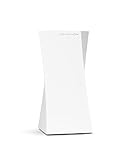
Two identical cylindrical units, each roughly 3.6 inches wide and 6.4 inches tall, form the entire system. Each carries two gigabit Ethernet ports, so one becomes your router, or access point, and the other becomes a satellite.
The kit ships with both units, two power adapters, a single Ethernet cable, and a quick start guide.
| Specification | Detail |
|---|---|
| WiFi standard | Wi-Fi 5 (802.11ac), dual-band |
| Rated speed | AC1900, 3×3 6-stream |
| Coverage | Up to 3,800 sq. ft. (2-pack) |
| Ethernet | 2 gigabit ports per unit |
| Device capacity | Up to 75 |
| Security | WPA-PSK / WPA2-PSK |
| Warranty | 2-year manufacturer |
Anyone comparing generations should look at our TP-Link Deco BE63 Wi-Fi 7 mesh review for the upper end of the same family.
Whole-Home Coverage up to 3,800 Square Feet
The 3,800 sq. ft. figure assumes open-plan construction and sensible placement, so treat it as a ceiling instead of a promise. In a two-story home with plaster walls or a finished basement, expect closer to 2,500 to 3,000 usable square feet from two units.
Placement drives results more than any setting in the app. Put the satellite roughly halfway between the main unit and the weak zone, at waist height or higher, and away from metal appliances and mirrors.
Homes larger than that scale by adding units. A third Deco covers most three-story layouts, and the system accepts additional Deco models on the same network without a second SSID.
Seamless Roaming and AC1900 WiFi Performance
Roaming works the way mesh should: one network name, one password, and automatic handoff as you walk between floors. Video calls generally survive the transition in practice, with a brief hiccup at worst.
AC1900 splits into 600 Mbps on 2.4 GHz and 1,300 Mbps on 5 GHz, which translates to real-world wireless throughput in the 300 to 500 Mbps range near the main unit. Satellite nodes on wireless backhaul lose roughly half of that, a normal trade for dual-band mesh.
The 75-device rating holds up for smart bulbs, cameras, and phones. Households running multiple 4K streams alongside heavy downloads will feel the Wi-Fi 5 ceiling, and a Wi-Fi 6 router like the Archer AX21 handles that density better.
Deco App Setup, Parental Controls, and Guest Access
Setup runs entirely through the Deco app on iOS or Android, and it takes about 15 minutes for the first unit plus a few more for the second. The app detects your connection type, names the network, and walks through satellite placement with a signal check.
Parental controls are profile-based. You assign devices to a family member, then set daily time limits and content filters by age category, which is enough for most households without needing a dedicated parental control router.
Guest WiFi runs on a separate SSID and toggles on or off through Alexa voice commands. The app also handles firmware updates, device prioritization, and a quick speed test against your ISP line.
Wired Backhaul and Router or Access Point Flexibility
Ethernet backhaul is the single biggest performance upgrade available here, and it costs nothing beyond a cable run. Connecting the satellite to the main unit by Ethernet frees the 5 GHz band entirely for client devices, restoring full speed at the far node.
If a cable run is impractical, powerline Ethernet adapters can carry the backhaul through existing wiring with decent results in newer homes.
Access point mode solves the ISP gateway problem. Fios and Xfinity subscribers who must keep the provider box for TV or voice service can leave it in place, disable its WiFi, and let the Deco handle wireless while the gateway keeps routing.
Pros and Cons
Pros
- Strong coverage per dollar, with two units reaching most mid-sized homes
- Genuinely simple app setup, no admin pages or IP addresses involved
- Wired backhaul support on all four gigabit ports
- Router and access point modes cover both ISP scenarios
- Profile-based parental controls included at no extra cost
- Expandable with any other Deco unit on the same network
Cons
- Wi-Fi 5 rather than Wi-Fi 6, so peak speeds trail newer kits
- Dual-band design means wireless backhaul shares the 5 GHz band
- Only two Ethernet ports per unit, one consumed by the modem on the main node
- No WPA3 security support
- Advanced controls like security scanning sit behind a subscription
What Customer Reviews Reveal
Thousands of buyers have weighed in, and the pattern is consistent: this is a coverage fix, not a speed record. Sentiment skews strongly positive across large-home installations and ISP gateway replacements alike.
What Buyers Praise Most
Setup speed comes up constantly. Owners describe the app walkthrough as painless, with printers and WPS devices joining without a fight, and several report the whole process finishing inside an hour.
Coverage results in three-story and 4,500 sq. ft. homes draw repeated praise, often after a Verizon Fios or similar gateway dropped connections regularly. One reviewer working as a data network technician deployed multiple three-unit kits across a multi-building mountain property and reported reliable performance.
Buyers also mention the unobtrusive white cylinders blending into shelves and side tables better than antenna-covered routers. Comparisons to a Netgear Nighthawk R7000P style single router usually favor the Deco on room-to-room consistency.
Common Limitations Reported
The most frequent surprise is that one unit must stay tethered to the modem by Ethernet, which catches buyers expecting a fully wireless system. It rarely becomes a dealbreaker, though it does constrain where the main node lives.
Some owners note that technical comfort helps during setup, particularly when configuring access point mode alongside an ISP gateway. A handful mention slower throughput at the far satellite when wireless backhaul is doing the work, which the Ethernet option resolves.
Conclusion
The Deco S4 earns its place for households whose problem is dead zones on a plan under 500 Mbps. Two units, a wired backhaul run if you can manage one, and thoughtful placement deliver stable coverage across most homes up to about 3,000 real-world square feet.
Gigabit fiber subscribers and heavy multi-stream households should look at Wi-Fi 6 or Wi-Fi 7 alternatives in our router reviews instead. For everyone else, this is the least expensive way to stop rebooting a router every week.
Buy the two-pack first, test coverage for a week, then add a third unit only if a specific room still lags.
Frequently Asked Questions
Is the TP-Link Deco S4 good enough for a large home?
Two units handle homes up to roughly 3,000 square feet reliably in typical construction, short of the 3,800 sq. ft. rating. Three-story houses and layouts with thick walls benefit from adding a third unit, which the system supports without changing your network name.
Does the Deco S4 work with Verizon Fios, Xfinity, and other internet providers?
Yes, it works with cable, DSL, and fiber providers including Fios, Xfinity, Spectrum, Cox, and CenturyLink. Most services need a modem or ISP gateway in front of it, and access point mode lets you keep that gateway when bundled TV or phone service requires it.
Can the TP-Link Deco S4 replace an existing router?
Yes, in router mode it fully replaces a standalone router connected to your modem. If your ISP supplies a combined modem-router, disable its WiFi and either bridge it or run the Deco in access point mode.
How many devices can the Deco S4 mesh system support?
TP-Link rates the system for up to 75 connected devices across both units. Smart home gear, phones, and streaming boxes fit comfortably within that count, though simultaneous heavy video streams will hit the Wi-Fi 5 bandwidth ceiling before the device limit.
Can I add more Deco units to a Deco S4 two-pack?
Yes, additional Deco units join the existing network through the app in a few minutes. Mixing models works, and the network keeps a single SSID, though the mesh performs at the capability level of the slower units involved.
Is the TP-Link Deco S4 a WiFi 6 system?
No, it uses Wi-Fi 5 (802.11ac) with an AC1900 dual-band rating. Wi-Fi 6 systems generally offer better performance in homes with lots of connected devices and on gigabit plans.
The S4 is aimed at buyers who want broader coverage on connections up to a few hundred megabits.
TechBytes

Our mission is to showcase the complex world of technology with comprehensive, accessible reviews. We bring you the freshest insights on everything from the most streamlined smartphones to the mightiest laptops, as well as the latest in smart home gadgets that simplify your daily routine and fitness wearables that monitor your well-being. Rest assured, we're here to guide you through the ever-evolving tech landscape.