
If your laptop turns into a space heater after an hour of video calls or a Steam session, a cooling pad is the cheapest fix available. The Havit HV-F2056 has held the top spot in its category for years, and this Havit HV-F2056 laptop cooling pad review looks at whether that reputation still holds up in 2026.
Built around three quiet fans, a perforated metal mesh surface, and two height settings, this pad weighs about 1.5 pounds and draws power straight from your laptop’s USB-A port. It fits machines from 15.6 to 17 inches, while the ABS frame keeps it thin enough to slide into a backpack sleeve.
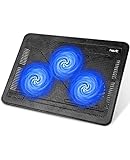
- Ultra-Portable: Slim, portable, and light weight allowing you to protect your investment wherever you go
- Ergonomic Comfort: Doubles as an ergonomic stand with two adjustable height settings
- Optimized for Laptop Carrying: The metal mesh provides your laptop with a stable laptop carrying surface

Owners routinely report years of daily use before anything goes wrong, which is unusual in a category full of disposable plastic. The trade-off, of course, is a USB-A cable in an increasingly USB-C world.
Bottom Line
For anyone running a warm 15-inch or 17-inch laptop on a desk or lap desk, this pad delivers real airflow and a better typing angle without adding much bulk or noise.
Check current availability and pricing for the Havit HV-F2056 on Amazon.
Havit HV-F2056 Laptop Cooling Pad Overview
Measuring 14.96 by 11.02 inches and just 1.18 inches thick, the F2056 feels more like a slim tray than a bulky gaming platform. The chassis is ABS plastic, with a full metal mesh deck spanning nearly the entire surface.
| Specification | Detail |
|---|---|
| Model | HV-F2056 |
| Laptop size | 15.6 to 17 inches |
| Fans | 3 |
| Dimensions | 14.96″ x 11.02″ x 1.18″ |
| Weight | 697 g (about 1.5 lbs) |
| Material | ABS with metal mesh |
| Power | USB-A, powered by laptop |
| Color | Black and blue |
Two rubberized stoppers along the front edge keep a laptop from sliding off at the raised angle. Compared with the heavier alternatives covered in our best notebook cooler roundup, the low profile is what makes this one easy to travel with.
Three Ultra-Quiet Fans for Everyday Cooling
Airflow comes from three 110mm fans arranged in a triangle beneath the mesh, and they run at a fixed speed with no controller dial. In practice, the sound is a low whoosh, quieter than most laptop fans running at full tilt.
Temperature drops depend heavily on your machine’s intake design. Laptops that pull air through the bottom panel see the biggest benefit, sometimes 5 to 10 degrees Celsius under sustained load. Sealed-bottom ultrabooks gain far less.
The mesh deck matters here, too. Because air reaches the entire underside rather than a single spot, heat spread across the palm rest also drops noticeably during long sessions.
Two-Level Ergonomic Height Adjustment
Flip-out feet at the rear provide two typing angles, and the taller setting lifts the back edge enough to relieve wrist strain during long writing sessions. Both positions lock firmly, then fold flat for transport.
The lower setting works well on a desk with an external keyboard. The higher one suits direct typing on the laptop, tilting the screen toward eye level and opening up more clearance for the intake vents.
If you’re rebuilding your whole desk setup, this pairs naturally with the ideas in our guide to ergonomic peripherals for productivity, where screen height and wrist angle deliver most of the comfort gains.
USB Pass-Through and Power Switch Convenience
A second USB-A port on the rear passes through the connection, so plugging in the pad doesn’t cost you a port. Mice, flash drives, and other low-draw peripherals work fine through it.
The inline power switch is the more useful detail. You can cut the fans during a quiet meeting, then restore them for a render or a game without unplugging anything.
Bear in mind that the pass-through shares bandwidth and power with the fans. High-draw devices belong on a dedicated port or a powered USB hub.
Pros and Cons
Pros
- Three fans deliver steady airflow at a genuinely low noise level
- Slim 1.18-inch profile and 1.5-pound weight travel easily
- Two-position stand improves typing angle and screen height
- Pass-through USB port and physical power switch
- Metal mesh supports the full footprint of a 17-inch laptop
- Long service life reported by owners across multiple years
Cons
- USB-A to USB-A cable requires an adapter on USB-C-only machines
- No fan speed control or RGB lighting
- Occasional units arrive with a rattling fan bearing
- Fixed fan placement may not align with every laptop’s intake vents
Customer Reviews and Long-Term Reliability
With tens of thousands of ratings and a strong average score, the F2056 has more feedback behind it than nearly any competitor in the category. The pattern across those reviews is pretty consistent: it works as described, and it lasts.
What Owners Like Most
Longevity dominates the positive feedback. One owner tracked theirs to just over six years of use before the fans failed, disassembling and cleaning them once around the four-and-a-half-year mark.
Quiet operation is the second recurring theme. Users running Dell, HP, MacBook, and older ThinkPad machines describe the noise as easy to ignore. Several also credit the pad with keeping a laptop with failing internal fans usable.
The generous surface gets plenty of praise as well. Owners with smaller 14- and 15-inch laptops report roughly two inches of clearance on each side, while 17-inch machines cover the deck completely.
Reported Fan and Cable Issues
Rattling fans are the most common complaint. Some units arrive with the noise out of the box, while a few develop it after a month. That points to bearing variance in individual units rather than an obvious design flaw.
Returns and replacements are handled quickly, according to those same reviewers. The other steady grumble concerns the USB-A cable, which several buyers only discovered midway through setup on a USB-C laptop.
Conclusion
The F2056 earns its category ranking through durability and restraint. There is no lighting, no speed dial, and no oversized frame. The result is a pad that reliably drops temperatures on bottom-vented laptops while staying thin enough to carry every day.
Buy it if you have a 15.6-inch or larger laptop that runs hot under sustained load and you value silence over adjustability. Skip it if you need per-fan speed control or want a stand that raises your screen to full monitor height.
Order a USB-C to USB-A adapter alongside it if your laptop lacks a full-size USB port. Check the fans during the return window, too, so you can swap out a rattling unit early. For side-by-side options, our Kootek laptop cooling pad review and Ice Coorel laptop cooling pad review cover close alternatives.
Frequently Asked Questions
Does the Havit HV-F2056 fit a 17-inch laptop?
Yes, the 14.96 by 11.02 inch deck accommodates laptops up to 17 inches. A 17-inch machine covers the mesh almost entirely, while 14- and 15-inch laptops leave about two inches of clearance on each side.
Is the Havit HV-F2056 quiet enough for work or studying?
The three fans produce a soft, consistent hum that stays below the sound of most laptop fans under load. Reviewers consistently describe it as unobtrusive during calls and study sessions, though a small number of units develop a rattle from a worn bearing.
How do you power the Havit HV-F2056 cooling pad?
It draws power from your laptop through the included USB-A cable, with no wall adapter needed. The rear pass-through port returns a USB connection, and the inline switch lets you turn the fans off without unplugging the cable.
Does the Havit HV-F2056 work with USB-C laptops?
It works with USB-C laptops only through an adapter, since the included cable is USB-A to USB-A. A basic USB-C to USB-A adapter or a dock with a spare USB-A port solves this for a few dollars.
Can the Havit HV-F2056 help reduce laptop temperatures while gaming?
It can lower temperatures during gaming on laptops that pull intake air through the bottom panel, with reported drops of around 5 to 10 degrees Celsius under sustained load. Machines with side or rear intakes tend to see smaller gains, though. And, really, no external pad can substitute for cleaning clogged internal heatsinks.
TechBytes

Our mission is to showcase the complex world of technology with comprehensive, accessible reviews. We bring you the freshest insights on everything from the most streamlined smartphones to the mightiest laptops, as well as the latest in smart home gadgets that simplify your daily routine and fitness wearables that monitor your well-being. Rest assured, we're here to guide you through the ever-evolving tech landscape.