
Powering a Jackery Explorer off the grid means either carrying extra fuel or catching sunlight, and the Jackery SolarSaga 100W folding solar panel makes the second option about as painless as portable solar gets. This renewed version puts a 100-watt monocrystalline panel in your hands at a lower entry point than buying new.
You get two built-in kickstands, a TPE rubber carry handle, magnetic closures, and a zippered pocket that holds the DC cable. At roughly 6 pounds and folding down to about 23 by 20 inches, it stows behind a truck seat or against a tent wall without much fuss.
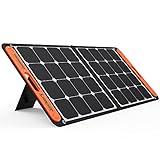
- About this item EASY SETUP & KICKSTAND INCLUDED: The Solar Saga 100 features 2 kickstands that can be placed firmly on any surface ground. With just a few seconds of setup, you can start soaking energy from the sun for your Jackery power station. The TPE rubber handle allows you to carry around easily when taking off-grid adventures.
- HIGHER ENERGY CONVERSION RATE: Covered by monocrystalline silicon solar cells, the solar panel adopts multi-layered cell technology to generate energy from the sunlight and perform better with higher conversion efficiency that up to 23% than other conventional panels.
- DURABLE & SPLASH-PROOF: The ETFE-laminated case is durable enough to extend the lifespan of the solar panel. It is IP65 water-resistant that will protect from water splashing (Do not place it under the rain, or to soak in water). The zippers on the pocket can hold the power cords, and cover the power port.

Renewed units ship with a six-month Jackery warranty, which is longer coverage than most refurbished electronics carry and removes much of the risk from buying secondhand solar.
The panel also carries a pair of USB ports on the side, so you can top off a phone or headlamp straight from the sun while your power station charges elsewhere.
Bottom Line
If you own an Explorer power station and want solar input without paying full retail, this renewed SolarSaga 100 is a sensible way in.
The build quality, fast setup, and warranty coverage make the savings worth taking.
Check current availability and pricing on the renewed Jackery SolarSaga 100W here.
Jackery SolarSaga 100W Portable Solar Panel Overview
Sunlight becomes usable wattage here through monocrystalline silicon cells rated at up to 23% conversion efficiency, feeding a Jackery Explorer through a single DC connector. The panel folds in half like a briefcase and weighs about 6 pounds.
Officially, compatibility covers the Explorer 240, 300, 500, 1000, and 1500. Pair it with an Explorer 1000 v2 power station and you have a recharge loop that never needs a wall outlet.
| Spec | Detail |
|---|---|
| Rated output | 100W |
| Cell type | Monocrystalline silicon |
| Folded size | 22.83 x 19.69 x 2.36 in |
| Weight | ~6 lbs |
| USB ports | USB-C (5V/3A), USB-A (5V/2.4A) |
| Water resistance | IP65 splash-proof |
| Warranty (renewed) | 6 months |
Who Is This Foldable Panel Best For?
Weekend campers, van dwellers, and anyone keeping a power station charged during outages get the most from it. Tailgaters and photographers working remote sites benefit from the fast deployment, too.
If you need a permanent rooftop array or want to charge a 2000Wh unit in a single afternoon, look toward multi-panel setups or other portable solar options with higher wattage.
Fast Fold-Out Setup and Integrated Kickstands
Deployment takes seconds. Unfold the two halves, flip out the pair of kickstands on the back, and angle the face toward the sun. No poles, no lanyards, no separate stand to misplace.
The kickstands hold steady on dirt, gravel, picnic tables, and truck beds. On grass, pressing them in slightly keeps the panel from sliding in a breeze.
Magnetic discs in the handles snap the folded halves together for transport, and the rubberized grip stays comfortable during longer carries. A zippered rear pocket swallows the DC cable, so nothing dangles when you pack up.
Repositioning through the day takes only a few seconds, and chasing the sun every couple of hours can meaningfully raise daily harvest.
Monocrystalline Cells and Real-World Solar Output
Multi-layered monocrystalline cells push conversion efficiency to roughly 23%, which is why a 100-watt panel this size stays under 6 pounds. ETFE lamination over the cells keeps light transmission high while shielding them from UV degradation.
That efficiency rating describes the cells under laboratory test conditions. What reaches your power station depends on sun angle, ambient temperature, cloud cover, and how clean the panel surface is.
Heat works against you. Panel cells lose output as they warm, so a 95-degree afternoon in Phoenix yields less per hour than a crisp 60-degree morning with the same sun overhead.
What Output Can Buyers Realistically Expect?
Owners consistently report 60 to 75 watts under clear midday sun with the panel aimed properly, which tracks with what a 100-watt portable panel delivers outside a lab.
Practical planning numbers:
- Direct sun, angled well: 60 to 75W
- Direct sun, laid flat: 40 to 55W
- Thin cloud or haze: 20 to 40W
- Heavy overcast: under 15W
An Explorer 500 refills in roughly 9 to 10 hours of good sun with one panel. For faster turnaround, pairing panels or stepping up to a 200W SolarSaga cuts that time considerably.
USB-A and USB-C Charging Ports
Two ports sit under the zippered flap on the panel’s back: a USB-C output at 5V/3A and a USB-A at 5V/2.4A. Both run independently of the DC output, so devices can charge while the power station does.
Those are modest 15W and 12W ceilings. A phone, GPS unit, headlamp, or earbud case charges fine, but a laptop or tablet needing USB-C PD will not.
Output fluctuates with passing clouds, which some phones interpret as a disconnect-reconnect cycle. Charging a small battery bank from the panel and then charging your phone from that bank produces steadier results.
ETFE Construction and IP65 Splash Resistance
The ETFE-laminated shell handles abrasion and UV far better than the PET coatings on cheaper folding panels, which is a meaningful part of why these units last through repeated field seasons.
IP65 means the panel shrugs off splashes, spray, and brief drizzle. Jackery draws the line clearly: do not leave it out in rain, and never submerge it.
The DC port and USB outputs sit inside a zippered pocket, keeping moisture and grit away from the contacts. Zip it closed whenever the panel isn’t actively cabled up.
Renewed units may arrive without the fabric case that some new panels include, and light scuffing along an edge is normal. The cells themselves are what determine performance.
Pros and Cons
Pros
- Setup takes seconds thanks to integrated dual kickstands with no assembly required
- Roughly 6 pounds and folds flat enough for a back seat or storage bin
- 60 to 75W real-world output in good sun, near the ceiling for this class
- ETFE lamination and IP65 rating hold up to dust, spray, and repeated packing
- Six-month warranty on renewed units, longer than most refurbished electronics
- Direct USB-A and USB-C charging works without a power station attached
Cons
- USB ports max out at 5V, ruling out laptops and PD-hungry tablets
- Not rain-safe; it needs to come inside when weather turns
- Renewed panels can show cosmetic scuffs and may ship without a carry case
- One panel recharges larger Explorer units slowly across a full day
- Output drops sharply under cloud cover or when laid flat
- Requires repositioning through the day for best results
Customer Reviews and Ownership Takeaways
Owner sentiment lands solidly positive, with buyers describing the panel as sturdy, quick to deploy, and easy to stow. Several own multiple Jackery panels and treat this one as their default field choice.
One reviewer measured a steady 64 watts with a clear line to the sun and considered that on target. Another, whose previous 100W Jackery panel failed after the warranty expired, found the newer version larger, with a longer cable and better performance.
Renewed buyers report honest condition: minor edge scuffing, a cable that looked new, and full functionality. The absence of a carry case on some units came up more than any performance complaint.
What Verified Buyers Praise Most
Portability leads the feedback. Campers repeatedly mention that the folded form disappears into a vehicle, and the built-in stand removes the fiddling that plagues panels with separate supports.
Owners running two Explorer 1000 units alongside smaller stations describe the panel as an obvious add-on, with output that met or exceeded what they expected from a refurbished unit.
Conclusion
Buying the renewed SolarSaga 100 makes sense when you already own an Explorer power station and want solar input without new-panel pricing. The six-month warranty covers the window where refurbishment defects would surface.
Expect 60 to 75 watts in strong sun, plan on repositioning it two or three times a day, and bring it indoors before rain. Those habits get the most out of the hardware.
If your Explorer is a 1000 or 1500 and you want same-day recharges, budget for two panels or compare against a 200W panel before committing. For an Explorer 240, 300, or 500, a single SolarSaga 100 keeps up with typical weekend draw.
Check the current listing for the renewed Jackery SolarSaga 100W.
Frequently Asked Questions
Is the Jackery SolarSaga 100W compatible with all Jackery power stations?
It connects directly to the Explorer 240, 300, 500, 1000, and 1500. Newer models and other brands use different input connectors and voltage ranges, so confirm your unit’s DC input specs before assuming it’ll work.
How much power does the SolarSaga 100W produce in real-world conditions?
Owners see 60 to 75 watts under clear midday sun with the panel angled toward it. That figure falls to 20 to 40 watts under haze or thin cloud, and below 15 watts in heavy overcast.
Can the Jackery SolarSaga 100W charge a phone directly?
Yes, through the USB-C (5V/3A) or USB-A (5V/2.4A) port on the back panel, with no power station required. Charging pauses when clouds pass, so running the panel into a battery bank and charging your phone from that gives steadier results.
Is the SolarSaga 100W waterproof enough to use in the rain?
No. The IP65 rating covers splashes and light spray, and Jackery specifies that the panel should not sit in rain or be submerged. Pack it up when weather moves in and keep the port pocket zipped.
Is a renewed Jackery SolarSaga 100W solar panel worth buying?
For most buyers, yes. Renewed units carry a six-month Jackery warranty and owners report full performance with only cosmetic wear, though some arrive without the carry case that ships with certain new panels.
Does the SolarSaga 100W include a Jackery power station?
No. The package contains the solar panel alone. Explorer power stations are sold separately, so you’ll need one to store the energy the panel collects. The exception is if you’re charging small devices directly through the USB ports.
TechBytes

Our mission is to showcase the complex world of technology with comprehensive, accessible reviews. We bring you the freshest insights on everything from the most streamlined smartphones to the mightiest laptops, as well as the latest in smart home gadgets that simplify your daily routine and fitness wearables that monitor your well-being. Rest assured, we're here to guide you through the ever-evolving tech landscape.
