Packing a solar panel makes sense once you accept what it does: it turns daylight into USB power while the sun is up, and nothing else. The BigBlue 28W High-Efficiency Solar Panel Charger has been a fixture in backpacks and hurricane bins for years, and the current version adds a second USB-C port and N-type cells to a design that already sold well.
At 1.5 pounds and roughly the footprint of a tablet when folded, it slots into a side pocket without much argument. This BigBlue 28W Solar Panel Charger review focuses on the practical question most buyers have: how much usable power you get on an average day, and whether that beats carrying one more power bank.
Advanced Performance: BigBlue 28W portable solar charger provides 20% more power from every ray, thanks to shadow-free surface design (No metal lines on the front panel). Engineered heat resistance and advanced N-type solar cells offer superior Low-Light efficiency and extending operational longevity
Upgraded Triple-Port: Dual USB-C and one USB-A ports deliver a maximum output of 5V/3A each, collectively achieving 5V/4.8A. This solar panel charger empowers simultaneous multi-device charging. Please note that the portable solar panel can't store the electricity and must be used in direct sunlight while connected to your devices
High-Efficiency & IP44 Waterproof: 28W USB solar panel phone charger converts 25.4% sunlight into free energy – industry-leading efficiency. Our most durable design with special polymer surface resists rain, fog, and wear better than conventional panels. Note: USB junction box is not waterproof
Three ports share a combined 5V/4.8A ceiling, the monocrystalline cells are rated at 25.4% conversion, and the polymer surface shrugs off rain and morning fog at an IP44 level. The junction box holding the ports is the part you’ll want to keep dry.
Bottom Line
If you camp, hike, or keep an emergency kit stocked, this panel earns its weight by keeping phones and power banks alive when outlets are gone.
BigBlue 28W High-Efficiency Solar Panel Charger Overview
Model B401D is a direct-charge folding panel with no battery inside, and that shapes every decision you make around it. Sunlight hits the monocrystalline cells and goes straight out the USB ports to whatever is plugged in.
The shadow-free front panel skips the metal grid lines found on cheaper panels. BigBlue rates the N-type cells for better heat tolerance and low-light output, too.
Spec
Detail
Rated output
28W, 5V
Ports
2x USB-C, 1x USB-A (5V/3A each, 4.8A total)
Folded size
11 x 6 x 1.4 in
Weight
1.5 lbs (671 g)
Water resistance
IP44 panel surface
In the box
Panel, 50cm USB-C to USB-C cable, carabiners, manual
It ranks near the top of Amazon’s cell phone solar charger category and ships in frustration-free packaging.
28W Solar Conversion and Low-Light Performance
Conversion efficiency of 25.4% puts this panel at the upper end of what folding USB panels achieve, and the practical result shows up on imperfect days. Owners in Sweden report around 2A in winter sun and roughly 1A under medium cloud cover, which is enough to keep a phone topped off.
Angle changes output more than most people expect. Laying the panel flat on the ground costs you real amperage compared with propping it toward the sun using the grommets and a bit of cord.
Heat is the other variable. The cells hold up better than older polycrystalline designs, but a panel baking at midday on dark rock still runs hotter than one with airflow underneath.
Triple USB Charging Ports for Multiple Devices
Two USB-C ports plus one USB-A let three people charge at once, with each port capable of 5V/3A and the array capped at 4.8A combined. Splitting the load means each device draws less, so pairing a phone with a headlamp works better than connecting three phones together.
The included 50cm USB-C to USB-C cable is short by design, keeping devices tucked in the panel’s shade. Lightning cables for iPhones aren’t included, so bring your own.
A blue LED on the junction box glows solid when the panel is feeding power correctly. That saves you from squinting at a phone screen in bright sun just to confirm it’s working. If you also carry a wall adapter for hotel nights, an Anker USB-C charger covers the other half of the trip.
Folding Design for Travel and Emergency Kits
Folded down to 11 x 6 x 1.4 inches, the panel fits a laptop sleeve or the outer pocket of a 40L pack. Travelers report clearing airport security with it flat in a carry-on and unfolding it at camp.
Four carabiners and reinforced eyelets let you strap the open panel to a pack lid while hiking, though output while walking is inconsistent because the angle keeps shifting.
For hurricane kits, the appeal is that nothing degrades in storage. There’s no lithium cell to lose capacity over three years in a closet, which is the failure mode that catches people with unused power banks. Compare that with the tradeoffs in backpacking solar panels built around larger arrays.
Setup Expectations and Best Uses
Unfolding the panel and plugging in takes under a minute, and the rest of the work is positioning. Face the cells squarely at the sun, keep the junction box shaded, and check the LED before walking away.
Windows and windshields kill output. Glass filters enough of the spectrum that indoor charging produces trickle-level current at best, so the panel belongs outside.
Why Is Charging a Power Bank Often the Smartest Approach?
A power bank absorbs inconsistent current gracefully, while phones interrupt charging every time a cloud passes. Plug the panel into a 20,000mAh bank in the morning, let it soak up whatever the day gives, then charge your phone from the bank at night.
One owner in the Netherlands filled a 20,000mAh bank from 67% to full in three hours on a partly cloudy day, with current swinging between 0.3A and 3.0A. A phone plugged in directly would have logged dozens of charge interruptions in that same window.
What Conditions Deliver the Most Reliable Output?
Clear midday sun between roughly 10 a.m. and 3 p.m., with the panel tilted perpendicular to the sun, gives you the closest thing to rated output. Cooler ambient temperatures help, which is why crisp spring days sometimes outperform July heat.
Partial shade is the enemy. A branch shadow across one cell drags down the whole string, so scan the ground before you set up.
Pros and Cons
Strong efficiency and low weight are the headline strengths; the absence of stored power is the main constraint.
Pros
Real output in cloudy and low-angle conditions, not just perfect sun
Three ports with a genuine 4.8A combined ceiling
Folds to tablet size at 1.5 pounds
IP44 surface handles rain, fog, and trail grit
No internal battery to age out in an emergency kit
Solid build quality reported across years of ownership
Cons
Charges nothing after sunset without a paired power bank
Junction box is not waterproof and needs shelter in rain
Underpowered for laptops or larger power stations
No Lightning cable included
Output drops sharply behind glass or in partial shade
What Customers Say About Everyday Reliability
Buyer sentiment clusters around a consistent theme: the panel works as described, at a pace set by the weather. Ratings are strong across a very large review base, with complaints concentrated on speed expectations and occasional unit-level defects.
Reports From Sunny and Cloudy Conditions
Owners in Arizona describe adding meaningful charge to a phone over a couple of hours in full desert sun. A traveler in Juneau, Alaska, reported the panel still pulling usable current through persistent overcast, which is the harder test.
European owners tracking amperage with inline meters describe a clear ladder: strong sun near 2.7A to 3.0A, light cloud around 1.5A, and medium cloud closer to 1A. A few buyers reported underperforming units and were able to reproduce the issue across two panels, so testing yours early is worth the effort.
Common Expectations Buyers Should Set
Direct phone charging feels slow because it’s competing against the phone’s own power draw and thermal limits. Several owners note their Samsung Galaxy S23 and S24 Ultra phones hit fast-charging speeds in strong sun, which shows the ceiling is device-dependent.
Sturdiness comes up repeatedly in first-impression reviews. The panel feels dense and well-stitched rather than flimsy, and long-term owners report it holding up through repeated pack-and-unpack cycles.
Conclusion
This panel suits anyone whose power problem is measured in days away from an outlet rather than hours. Pair it with a 20,000mAh or larger bank and you have a system that refills itself every clear morning.
Skip it if you need to run a laptop, a CPAP, or anything drawing more than USB-level power; that job belongs to a portable power station with a larger panel array feeding it.
For hurricane kits, weekend backpacking, and long overland trips, the combination of 1.5 pounds, three ports, and genuine cloudy-day output is hard to beat at this size. See the BigBlue 28W panel on Amazon.
Frequently Asked Questions
Are BigBlue solar panels good for camping?
Yes, the 1.5-pound weight and 11 x 6 x 1.4-inch folded size make this a practical camping panel for phones, headlamps, GPS units, and power banks. Strap it to your pack lid while hiking or set it up at camp during midday hours for the best return.
How much does the BigBlue 28W solar charger weigh?
It weighs 1.5 pounds, or 671 grams. That figure covers the panel and its integrated junction box, so add a few ounces for cables and carabiners when you calculate pack weight.
Can the BigBlue 28W charger charge a phone in cloudy weather?
Yes, though at reduced current. Owners report roughly 1A under medium cloud cover and about 1.5A in light cloud, compared with 2.7A or more in direct sun, which means charging continues at a slower pace instead of stopping.
Does the BigBlue 28W solar charger have a built-in battery?
No, this is a direct-charge panel with no internal storage. Power flows only while sunlight hits the cells, so pair it with a power bank if you want energy available after dark.
Can the BigBlue 28W solar charger charge a laptop?
No, the 5V USB output falls well short of what laptops and large power stations require. Stick to phones, tablets, power banks, headphones, speakers, and similar small electronics.
Why should devices stay in the shade while charging?
Phones and tablets have thermal protection that throttles or halts charging when they get hot. Sitting in direct sunlight beside the panel can trigger that protection, so tuck the device under the panel or inside a bag while the cable stays connected.
Our mission is to showcase the complex world of technology with comprehensive, accessible reviews. We bring you the freshest insights on everything from the most streamlined smartphones to the mightiest laptops, as well as the latest in smart home gadgets that simplify your daily routine and fitness wearables that monitor your well-being. Rest assured, we're here to guide you through the ever-evolving tech landscape.
Our mission is to showcase the complex world of technology with comprehensive, accessible reviews. We bring you the freshest insights on everything from the most streamlined smartphones to the mightiest laptops, as well as the latest in smart home gadgets that simplify your daily routine and fitness wearables that monitor your well-being. Rest assured, we're here to guide you through the ever-evolving tech landscape.
In an era of technology and connectivity, the ability to maintain power for devices while exploring the wilderness has become increasingly important. Outdoors enthusiasts often rely on solar panels during their backpacking trips to keep GPS devices, smartphones, and cameras charged. A backpacking solar panel is a portable energy solution that harnesses sunlight to generate electricity, offering a sustainable source of power when off the grid.
Backpacking solar panels offer a reliable option for travelers looking to sustain their electronic devices during long hikes. These panels are typically designed to be lightweight and compact, making them easy to attach to a backpack or set up at a campsite. The efficiency of a solar panel, its ability to convert sunlight into electrical energy, is a crucial factor that affects its performance. Since backpackers are frequently on the move and face varying weather conditions, the best solar panels for this purpose are those that are weather-resistant and able to charge efficiently in different light conditions.
When considering a purchase, the key attributes to look for are panel efficiency, weight, durability, and charging capability. Higher efficiency panels will yield a greater energy output in a given amount of time, thus expediting the charging process. However, this should be balanced with the form factor, as carrying a bulky solar panel could hinder one’s mobility on the trail. Additionally, the chosen panel must be robust enough to withstand the rigors of outdoor travel, including exposure to the elements.
Identifying the most suitable backpacking solar panel entails assessing specific needs against the backdrop of product features and efficiency. Engaging in this assessment will enable hikers and outdoor adventurers to choose a solar panel that not only meets their power demands but also enhances their overall backpacking experience. With a wealth of options available, determining the best backpacking solar panel involves careful consideration of these diverse factors, ensuring that travelers remain connected, even in the remotest of locations.
Top Backpacking Solar Panels
For backpackers who prioritize staying connected and powered while on the trail, a reliable solar panel is a must-have. The following list comprises the most efficient and durable solar panels suitable for backpacking adventures. These carefully selected models offer a balance of portability, power output, and ease of use, ensuring adventurers can harness the sun’s energy wherever their journey takes them.
Advanced Performance: BigBlue 28W portable solar charger provides 20% more power from every ray, thanks to shadow-free surface design (No metal lines on the front panel). Engineered heat resistance and advanced N-type solar cells offer superior Low-Light efficiency and extending operational longevity
Upgraded Triple-Port: Dual USB-C and one USB-A ports deliver a maximum output of 5V/3A each, collectively achieving 5V/4.8A. This solar panel charger empowers simultaneous multi-device charging. Please note that the portable solar panel can't store the electricity and must be used in direct sunlight while connected to your devices
High-Efficiency & IP44 Waterproof: 28W USB solar panel phone charger converts 25.4% sunlight into free energy – industry-leading efficiency. Our most durable design with special polymer surface resists rain, fog, and wear better than conventional panels. Note: USB junction box is not waterproof
Outdoor enthusiasts would find the BigBlue 28W Solar Charger a reliable companion for its efficient charging capabilities and durable design.
Pros
Compatible with multiple devices, facilitating simultaneous charging
High solar panel conversion efficiency for quicker charging in sunlight
Compact and lightweight, ideal for backpacking and emergency preparedness
Cons
Not suitable for charging in low-light conditions
Cannot be used to charge laptops or larger electronics
Requires additional cables for certain devices, like Apple products
Hefting the BigBlue solar charger on my latest backpacking trip was a breeze, with its lightweight and foldable design fitting snugly into my pack. While traversing sunny trails, I found it exceptionally easy to clip the charger onto my backpack, allowing me to power up my devices on the go. The charger’s durability was evident as it faced the rugged outdoors without any sign of wear or tear.
In full sunlight, the device proved highly effective, topping off my smartphone’s battery with reassuring speed. The three USB ports were a godsend, letting me charge not only my phone but also my camera and portable speaker, all with room to spare for my hiking partner’s gadgets.
However, it was on overcast days that I felt the charger’s limitations. The solar panel’s reliance on bright sunlight meant slower charging times, nudging me to manage my power usage more carefully. Additionally, while hiking through remote areas, I pondered the usefulness of the charger for those carrying laptops, a device it unfortunately cannot accommodate.
In short, the BigBlue 28W Solar Charger shines for the right user—someone in need of a lightweight, efficient, and sturdy power source for smaller electronic devices during sun-drenched outdoor adventures.
【High-Efficiency USB Solar Chargers】 Equipped with dual output ports (1× USB-A and 1× USB-C), this solar charger delivers up to **15W per port** individually. When both ports are used simultaneously, each port intelligently adjusts to a maximum of **10W** for balanced, stable power delivery. Charge smartphones, tablets, power banks, USB fans, smartwatches, and other 5V devices **directly under sunlight**. Ideal for outdoor emergencies, road trips, or off-grid adventures. *Note: This charger does not store energy. For nighttime use, pair it with a rechargeable battery pack (charged via the solar panel during daylight).
【Ultra-Portable Solar Panels】 Weighing just **0.99 lbs (450g)**, these foldable panels combine portability with power. Unfolded dimensions: 18×12×0.6 inches; folded size matches a standard iPad (12×9.8×0.6 inches). Easily fits into backpacks, car compartments, or even your hand! Four reinforced hanging holes and included carabiners let you attach the panels to your backpack while hiking, camping, or trekking—keeping devices charged on the go.
【Smart Charging Sun Power Panels】Integrated IC automatically make the auto-restart function which allows consistent charging becomes reality even when moving in or out of the shadow and detects the connected devices and provides the optimized charging, and an included LED light shows the charging status. The red light is on and means that solar panel is normal and you can chage your devices. FlexSolar ensure safe charging with overcurrent, overheating and short-circuit protection.
Outdoor enthusiasts seeking an efficient and durable solar charging solution will find the FlexSolar 20W Charger a reliable companion on their adventures.
Pros
Exceptionally lightweight and foldable for portability
Equipped with both USB-A and USB-C ports for versatile charging
Built with ETFE lamination for durability and weather resistance
Cons
Cannot store power for use without sunlight
Maximum power limited when using both USB ports simultaneously
Junction box is not waterproof
Hefting the FlexSolar 20W Charger, one immediately notices its lightness and compact form. Its folding design makes it no more cumbersome than carrying a tablet, slipping unobtrusively into any backpack. On reaching camp, the device unfurls easily, ready to soak up the sun’s rays.
The charger’s performance in direct sunlight impresses, efficiently powering devices and making one feel a bit more secure even in the wilderness. Its dual USB ports, catering to both USB-A and USB-C connections, mean that both a phone and a power bank can be topped up simultaneously, ensuring one stays connected.
Durability is another hallmark of the FlexSolar charger. The ETFE lamination stands up to the rigours of outdoor use, enduring abrasions and resisting water, aside from the non-waterproof junction box. It’s clear this solar panel is made to withstand diverse environmental challenges.
In summary, the FlexSolar 20W Charger emerges as a solid choice for hikers and backpackers who prioritize energy efficiency and equipment resilience. The convenience of its lightweight, foldable design, coupled with its robust ETFE construction, makes it an ideal piece of gear for off-grid power. Though its inability to store electrical energy might require some planning, its reliable performance under the sun is reassuring.
24% HIGH CONVERSION RATE: Made of 3 well-build monocrystalline silicon panels, using high transmittance ETFE coating and micro-concave-convex design, an important specification of this solar panel is a conversion efficiency of up to 24%, which is one of the highest available. It is a ready-to-go solution for the camping backpacking
DUAL USB OUTPUT POTRTS: With 2 USB output ports (5V/3A per port, 5V/4A Max when using both USB 1 and USB 2.), it can charge 2 devices at the same time. Equipped with TIR-C technology and automatic charging, it automatically recognizes connected devices and delivers optimal current. [Please note that this product has no DC output, so it cannot charge your power stations.]
DURABLE & IP54 WATERPROOF: The well made ETFE laminate coating on the solar panel is highly waterproof, flame retardant, dustproof and self-cleaning, making this portable solar charger virtually indestructible and extremely durable. The Oxford cloth on the back is waterproof IP54, which protects against occasional rain and wet fog. Please keep the USB port dry when charging
For those in need of reliable off-grid power, the ELECAENTA charger is a robust companion, offering impressive efficiency in sunlight.
Pros
Achieves a high energy conversion rate, suitable for the tech-savvy backpacker
Capable of charging multiple devices simultaneously
Constructed with durable materials, built for outdoor resilience
Cons
Absence of a DC output limits charging to USB-compatible devices only
Waterproofing does not extend to the USB ports, requiring extra caution
Given its size when unfolded, finding the optimal charging spot might take some maneuvering
Tucked away in the wilderness, with the ELECAENTA in hand, power scarcity becomes a concern of the past. The solar panels unfold effortlessly, revealing a surprisingly light device given its durable build. The ETFE coating gleams under the sun, almost as eager as I am to see the devices spring back to life.
The dual USB ports are a thoughtful touch, allowing one to share the sun’s generosity with a friend or charge additional gadgets. Despite the lack of a DC outlet — a limitation I am willing to overlook — the device is indeed attentive, discerning the needs of my smartphone and tablet, catering to them with the appropriate charge.
True, I must be protective of the USB area when weather turns sour, but considering the ELECAENTA’s tenacity against the elements, it’s a small price. While its spread can be broad when splayed out beneath the midday sun, finding an ample spot proves to be part of the day’s adventure.
In such a compact form when folded, it’s a piece of cake to clip it onto my backpack with the carabiners provided, and hike into the great unknown. It’s an empowering feeling, knowing that as long as the sun is in the sky, my connection to the world remains within my grasp.
USB Solar Panel:With 2Pcs mini solar panels and 1* USB parallel cable. Each panel has usb-a output port(max 5v/1a), can directly in the sunlight to charge your iphones, security camera, flashlight and other small devices. Can also run connection between solar panel to do DIY projects,such as charge usb fan for the small chicken coop,etc.The total USB output cann't charge apple devices in case of the connection between two panels. Charging apple devices with single panel.
Portable Solar Chargers: Small size lightweight which the size is 10.66in x 6.88 x 0.1in and the weight is only 0.5 lbs and 4 metal holes design. Easy to carry around and use for outdoor emergency power, such as camping,hiking or backpacking. We provide you 2 free carabiners, which are good for you to hang on your backpack, tent, or tree, even when you are walking or resting, it will not prevent to power your equipment. Note:solar panels cann’t store the power.
High-efficiency solar panels:Made of the A+ Monocrystalline Cell and PET film lamination, can effectively convert solar energy into electricity, with a conversion rate of up to 24%. IP67 Protection waterproof grade which can work under unexpected weather and improve a longer life for your solar panels.
Outdoor enthusiasts should consider the FlexSolar Mini Panels for their compact design and functional versatility on the trail.
Pros
Highly portable with a lightweight and thin profile
Straightforward and convenient USB charging for small devices
Durable and waterproof construction suitable for outdoor conditions
Cons
Limited charging capability with maximum output at 5V/1A per panel
Cannot charge multiple power-intensive gadgets at full speed simultaneously
Not designed for substantial energy storage or charging larger devices
As someone who spends a fair amount of time in the great outdoors, the FlexSolar Mini Panels have been an integral part of my backpacking gear. Their slim form factor and feather-like weight of just 0.5 lbs per panel means I can easily slip them into my pack without feeling bogged down. With the added carabiners, hanging the panels on my backpack for a charge on the go is a breeze.
The direct USB output capability is a standout feature. During a day-long hike, it kept my security camera and flashlight fully charged. Of course, with the sun playing its part, my devices were energized and ready for the night ahead. The panels’ intelligent chip ensuring safe charging is a reassurance that my gear remains in good condition.
Their weatherproof rating and high-efficiency solar cells are assets in unpredictable weather. I recall a trip where a sudden downpour ensued, and yet, these robust panels continued their solar magic, unhampered. However, it should be noted that while they’ve been reliable for small gadgets, more power-hungry devices like tablets would take significantly longer to charge, especially if the weather is overcast. The efficiency of the panels can vary with environmental conditions, which isn’t surprising but is definitely a factor to consider when depending on solar power.
In summary, the FlexSolar Mini Panels are a travel-friendly solution for keeping small devices charged during outdoor adventures. Although they may not replace heavier duty charging options, they complement the minimalist traveler aiming for a light and low-maintenance setup.
Hiluckey 25000mAh Solar Charger
No products found.
The Hiluckey Solar Charger is a robust companion for multi-day hiking trips, offering peace of mind with its renewable energy source and ample storage capacity.
Pros
Large battery capacity sustains devices over extended trips
Four-panel design maximizes solar intake for reliable charging potential
Integrated flashlight proves indispensable in emergency situations
Cons
Solar charging is slower compared to plugging into an outlet
Bulkier and heavier than non-solar counterparts
Hanging mechanism less intuitive than competitors
Having the chance to test the Hiluckey 25000mAh Solar Charger has been a revelation. On a week-long trekking adventure, the solar charger’s meaty battery capacity was a lifeline, keeping a smartphone full of life for days. It was impossible not to appreciate the thoughtfulness behind the design; four expansive solar panels unfolded like a sunflower towards the daylight, drinking in the rays with an efficiency that was impressive for a portable device.
While the charm of solar power is its off-grid energy source, one must note that the solar charging process isn’t without its sluggish moments, especially on days when the sun plays hide and seek. With USB-C fast charging, though, the tides turn rapidly when near a power source. Devices perk up briskly, ensuring minimal downtime from all action.
Out in the wild, the charger’s built-in flashlight did more than just illuminate the path; it added a layer of safety during night-time sojourns. Although it tacked on extra weight, the trade-off for a powerful dual-purpose tool was justified. Carrying it, however, did require some rigging genius since its attachment loop called for a bit of improvisation, differing slightly from other backpack-friendly solar chargers.
In essence, the Hiluckey charger confidently walks the line between modern convenience and outdoor ruggedness. It stands as a testament to the power of harnessing the sun, fitting beautifully into the life of any adventurer who seeks to stay connected, even in the most remote corners of the world.
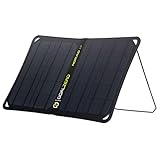
HIGH EFFICIENCY PANEL: The 10W, 6-7V Panel has a built in USB port, great for small device charging
LIGHTWEIGHT: Weighs 1.2 lbs, Fits almost anywhere at 9.5x14.5x.75"(unfolded), 9.5x7.2x1.2"(folded)
VERSATILE: Hook it on your backpack while hiking, or prop it up with the 180° adjustable kickstand
For avid backpackers looking to keep their devices charged, the Goal Zero Nomad 10 is a sturdy choice with user-friendly features.
Pros
Portability is top-notch due to its lightweight design.
Built-in USB port enhances the convenience of charging on the go.
The adjustable kickstand allows for optimal solar positioning.
Cons
It may feel slightly heavier compared to ultralight panels.
Charging efficiency dips in low-light conditions.
Premium build quality comes at a higher price point.
On a recent backpacking trip, this solar panel was a game-changer. The lightweight yet rugged design allowed me to attach it securely to my backpack, making the most of the day’s sunlight. Its compact size did not impede any mobility, and I hardly noticed the extra weight.
The Nomad 10 features an integrated USB port which makes for hassle-free charging. Phones, cameras, and even a GPS device reached full power efficiently. The high-efficiency panel performed admirably under the clear sky.
Having the ability to prop the panel at various angles thanks to the adjustable kickstand ensured I could easily find the perfect sun-catching position at rest stops. Although a bit pricier than some competitors, the dependable performance and robust construction justify the cost. On overcast days, however, patience was key as the power trickle was slow.
The Goal Zero Nomad 10 stands as a reliable companion for outdoor adventurers. Its solid build and thoughtful design cater well to sustained use in the wilderness, keeping your essential gadgets energized.
Buying Guide
Power Output
When selecting a solar panel for backpacking, the power output is crucial. Look for panels that offer sufficient wattage to charge the devices intended for use. Most backpacking solar panels range between 10W to 40W.
10-15W: Suitable for charging smartphones or GPS devices.
20-25W: Can charge several devices or a small tablet.
30-40W: Best for multiple devices, including larger tablets.
Weight and Portability
As backpackers need to carry their gear, the weight and size of the solar panel are vital.
Lightweight (< 20 oz): Ideal for minimalists.
Moderate (20-30 oz): A balance between efficiency and portability.
Heavier (> 30 oz): For those prioritizing power over weight.
Durability
Backpacking equipment must withstand outdoor conditions. Seek solar panels with rugged design and materials that are:
Water-resistant: For protection against rain.
Scratch-resistant: To extend life span.
Reinforced corners/edges: For added durability.
Efficiency
Efficiency determines how well a panel converts sunlight into electrical energy. Higher efficiency panels work better in varying conditions.
Efficiency Range
Consideration
High (>20%)
Performs well in most environments
Moderate (15-20%)
Effective in bright conditions
Low (<15%)
May struggle in less sunlight
Additional Features
Additional features can enhance the backpacking experience.
Integrated Battery: Allows energy storage for later use.
USB Ports: Essential for direct device charging.
Foldability: Increases compactness for travel.
Examine these features to ensure the solar panel meets specific backpacking needs without compromising essential factors like weight and durability.
Frequently Asked Questions
Selecting the right backpacking solar panel involves considering various features such as efficiency, durability, and power output. These FAQs aim to help backpackers choose the appropriate solar charging solution for their needs.
What should I look for in a high-quality backpacking solar panel?
A high-quality backpacking solar panel should have a robust build to withstand outdoor conditions, high efficiency for optimum sunlight conversion, and be lightweight for easy portability. Look for panels with a power output suitable for your devices and an appropriate surface area to capture sufficient sunlight.
How do I compare the efficiency of different solar panels for camping?
Efficiency is compared by looking at the power output relative to the size of the solar panel. Check the panel’s rated power and divide it by the surface area to get the efficiency. Additionally, review the solar cell type, as monocrystalline cells typically offer higher efficiency compared to polycrystalline cells.
Can you recommend a durable solar charger that’s suitable for backpacking?
For backpacking, a solar charger with a rugged design and resistance to weather elements is ideal. Brands like Anker and Goal Zero are reputable for producing durable solar chargers with features like reinforced corners and water-resistant materials.
What are the pros and cons of portable solar power banks for outdoor survival?
Portable solar power banks offer the convenience of storing energy for later use, which is beneficial during periods of low sunlight. However, they can be heavier and more expensive than direct solar chargers. Balance between the energy storage capacity and portability is crucial.
Is an ultralight solar panel effective enough for my backpacking needs?
An ultralight solar panel can be effective for backpacking if it provides adequate power for your devices and has enough surface area to compensate for its lightweight, thin design. They are effective for low-energy devices like smartphones and GPS units, but may not be sufficient for larger energy demands.
How much power do I really need from a solar panel to support my camping electronics?
Calculate the total watt-hours your devices consume per day and compare this with the solar panel’s output under optimal conditions. Panels around 10-20 watts are typically enough for charging small electronics, while larger setups may be needed for multiple devices or power-hungry equipment.
Our mission is to showcase the complex world of technology with comprehensive, accessible reviews. We bring you the freshest insights on everything from the most streamlined smartphones to the mightiest laptops, as well as the latest in smart home gadgets that simplify your daily routine and fitness wearables that monitor your well-being. Rest assured, we're here to guide you through the ever-evolving tech landscape.