
If you carry a phone, a tablet, and maybe a set of earbuds through long travel days, a battery that holds enough charge for the whole trip becomes more useful than a slim pocket pack. The Anker Power Bank with 26,800 mAh capacity has been a fixture in that category for years, and it still holds a strong rating from tens of thousands of buyers.
This is the older PowerCore-style design: three USB-A outputs, two Micro-USB inputs, and no USB-C anywhere on the housing. That single design decision defines who should buy it, because you get days of backup power at a low price, but you also need USB-A cables for everything you plan to charge.
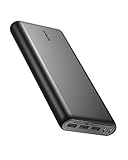
- The Anker Advantage: Join the 50 million+ powered by our leading technology.
- Charge 3 Devices at Once: 3 USB output ports (no A-C cables included) together with Anker's PowerIQ and Voltage Boost technology ensure charging for three devices simultaneously (not compatible with Qualcomm Quick Charge).
- High-Speed Charging: 3 USB output ports equipped with Anker's PowerIQ and Voltage Boost technology ensure high-speed charging for three devices—simultaneously (Not compatible with Qualcomm Quick Charge).

Anker’s PowerIQ and Voltage Boost circuitry handle output detection on all three ports, each capable of up to 3A, with 6A total across the pack. Recharging happens through the two Micro-USB inputs, which cut refill time roughly in half compared with a single-input pack.
Bottom Line
For camping trips, long-haul flights, and family travel where several phones need topping up, this Anker battery still earns its place in a bag. Check the current listing and pick up the Anker 26,800 mAh power bank here.
Anker Power Bank 26800 mAh Overview
Model A1277 is a lithium-ion brick measuring 7.1 x 3.2 x 0.9 inches and weighing about 495 grams with packaging materials, with the battery itself at 398 grams. The black plastic shell has a matte finish and a four-LED status readout.
Three USB-A ports sit along one edge, with two Micro-USB inputs beside them. Anker includes two Micro-USB cables and a welcome guide, plus an 18-month warranty.
No wall charger comes in the box, and no USB-C or Lightning cable is supplied. Rated output is 5V at 6A total, 3A maximum per port.
It does not support Qualcomm Quick Charge, so Android phones that rely on QC will charge at standard speeds. Buyers who want higher wattage and modern protocols should look at the Anker Prime 27,650 mAh 250W portable charger instead.
26800 mAh Capacity for Multi-Day Backup Power
Capacity is the headline reason to choose this pack over lighter options. Nearly 27,000 mAh of cell capacity gives you a genuine multi-day buffer when outlets are scarce.
Rideshare drivers, festival-goers, and anyone working from a car or campsite get the most from that reserve. Owners describe going a full week on a single fill when the pack only tops up one phone.
Conversion losses mean you never extract the full rated figure. Voltage step-up and heat typically consume 25 to 35 percent, which is normal for every lithium-ion pack of this class.
That also explains why some buyers report a lower usable number than the label.
How Many Phone Charges Can It Deliver?
| Device | Battery size | Approximate full charges |
|---|---|---|
| iPhone 15 | ~3,349 mAh | 5 to 6 |
| Samsung Galaxy S24 | ~4,000 mAh | 4 to 5 |
| iPad mini | ~5,100 mAh | 3 to 4 |
| iPad Air | ~7,600 mAh | 2 |
Those numbers assume moderate ambient temperature and no simultaneous use of the phone while charging. Streaming video during a top-up cuts the count noticeably.
Three USB-A Ports for Charging Multiple Devices
All three outputs carry identical specifications, so there is no “fast port” you need to hunt for. Each delivers up to 3A, with the pack capping total draw at 6A.
PowerIQ reads what each connected device requests and matches the current accordingly. In practice, that means a phone, a tablet, and a Bluetooth speaker share the load without you managing which port goes where.
Since the ports are USB-A, pairing this pack with a set of retractable USB cables keeps a travel kit tidy. If your household leans toward USB-C wall bricks, an Anker USB-C charger covers the other half of your charging setup.
Who Benefits From Three Simultaneous Outputs?
Families sharing one battery on a road trip get obvious value, since three passengers can plug in at once without arguments over a single port.
Photographers and content creators charging a camera battery grip alongside a phone also benefit. So do people running a phone plus a portable fan or headlamp at a campsite, where the pack becomes the only power source available.
Dual Micro-USB Input and Recharge Speed
Two Micro-USB inputs let the pack accept up to 4A combined, 2A per port, for a 20W refill. Using both inputs together brings a full recharge down to roughly six hours.
Refilling through a single input roughly doubles that window, which is where most complaints about slow recharging originate. Plugging the pack in overnight resolves the issue for most owners.
Micro-USB feels dated in 2026, and the two included cables become dedicated recharge cables you keep with the battery. Losing them means buying replacements, since Micro-USB cables have thinned out in most homes.
What Is Needed to Reach the Faster Recharge Time?
You need two wall adapters, or one adapter with two ports capable of 2A each, and both supplied Micro-USB cables running simultaneously.
A low-output 1A adapter drags the process out considerably. A multi-port wall unit such as those covered in this roundup of Anker charging stations and power strips makes the dual-input trick practical without occupying two outlets.
USB-A-Only Connectivity and Cable Compatibility
Every output on this model is USB-A, and every input is Micro-USB. Charging a USB-C phone requires a USB-A to USB-C cable, and an iPhone with a Lightning port needs a USB-A to Lightning cable, neither of which ships in the box.
That catches some buyers off guard, and it shows up repeatedly in owner feedback. Budgeting for a cable or two alongside the purchase avoids the frustration.
The upside of USB-A is universal compatibility with older accessories, car adapters, and hand-me-down cables. Readers who want native USB-C in and out should compare the Anker 24,000 mAh 3-port portable charger, which brings the port layout up to date.
Is It a Good Match for USB-C Phones?
It works with USB-C phones as long as you supply the right cable, though charging speed stays limited to 5V/3A, around 15W. A Galaxy S24 or iPhone 16 fills up at a moderate pace instead of the 25W to 45W those phones support.
For overnight or in-bag charging, the speed difference barely registers. For a 20-minute airport top-up, a USB-C Power Delivery pack serves you better.
Anyone comparing formats can review the broader USB-C coverage for context.
Size, Weight, and Travel Practicality
At roughly 1.1 pounds and about the footprint of a paperback, this pack lives in a bag rather than a pocket. Owners consistently describe the weight as the one real trade-off, with several noting it feels heavier than it looks.
The dimensions suit a backpack sleeve, a glovebox, or a camera bag. Jeans pockets are out of the question.
If daily carry weight is your priority, the Anker 10,000 mAh portable charger covers a single phone at a fraction of the bulk. For off-grid trips where recharging isn’t possible, a solar power bank makes a reasonable companion.
Can You Take a 26800 mAh Power Bank on a Flight?
Yes. At 5V nominal, 26,800 mAh works out to roughly 99 watt-hours, sitting just under the 100 Wh threshold the FAA and TSA allow in carry-on baggage without airline approval.
Pack it in your carry-on, never in checked luggage. Some airlines have added rules about using power banks during flight, so check your carrier before departure.
Pros and Cons
Pros
- Large 26,800 mAh reserve covers several days of phone charging
- Three identical USB-A ports, each rated to 3A
- Dual Micro-USB input cuts recharge time to about six hours
- Two Micro-USB cables and an 18-month warranty included
- Long track record of durability reported by multi-year owners
- Competitively priced for the capacity
Cons
- No USB-C port for input or output
- Micro-USB recharging feels dated and requires the included cables
- Around 1.1 pounds, too heavy for pocket carry
- Not compatible with Qualcomm Quick Charge
- No wall adapter, USB-C cable, or Lightning cable in the box
- Usable capacity lands below the rated figure after conversion losses
What Customer Reviews Reveal
Feedback across tens of thousands of buyers skews strongly positive, with durability the recurring theme. Several owners report daily use stretching past five and even seven years with the pack still performing.
Anker’s customer service also draws praise. One reviewer who received a faulty unit raised their rating after a replacement arrived within a couple of days.
Long-Term Reliability and Daily Use
A rideshare driver using the battery heavily four days a week reported more than a year of trouble-free service running navigation and multiple apps.
Travelers describe recharging a phone several times across a day in foreign cities without needing an outlet. One long-term owner charged an iPhone X roughly eight times from a single fill.
The consensus among repeat Anker buyers is that build quality holds up, echoing their experience with the brand’s cables and hubs.
Common Complaints About Weight and Charging
Weight comes up most often. Multiple owners note the pack is roughly twice the mass of the phone it charges and awkward to carry in a pocket.
Charging speed is the second complaint, particularly when only one input is connected during a refill. A few buyers were surprised that the usable output falls short of the printed 26,800 mAh figure, which reflects standard conversion loss.
Conclusion
This Anker battery makes sense when capacity and price matter more than modern ports. You get days of backup power, three ports that behave identically, and a pack with a documented history of surviving years of daily use.
Skip it if your gear is USB-C throughout and you want fast Power Delivery charging, or if you need something pocket-sized. For those cases, a smaller pack or a USB-C model fits better.
Before ordering, add a USB-A to USB-C or USB-A to Lightning cable to your cart, plus a 2A-capable wall adapter, or two, if you want the six-hour recharge. View the current listing on Amazon.
Frequently Asked Questions
How many times can the Anker 26800 mAh power bank charge an iPhone?
An iPhone 15 gets roughly five to six full charges from a single fill. Larger phones like the iPhone 15 Pro Max land closer to four, since conversion losses reduce the deliverable capacity below the rated 26,800 mAh.
Does Anker PowerCore 26800 model A1277 have USB-C charging?
No. This model uses three USB-A output ports and two Micro-USB input ports only. To charge a USB-C device, you need a USB-A to USB-C cable, and the pack itself recharges exclusively through Micro-USB.
Can the Anker 26800 mAh power bank charge three devices at once?
Yes, all three USB-A ports work simultaneously. Total output is capped at 6A with a maximum of 3A per port, and PowerIQ allocates current based on what each connected device requests.
How long does it take to recharge the Anker PowerCore 26800?
Just over six hours when both Micro-USB inputs are connected to 2A wall adapters. Using a single input roughly doubles that time, which is why the dual-input setup is worth arranging.
Is a 26800 mAh power bank allowed on a plane?
Yes, in carry-on baggage. At 5V, this pack calculates to approximately 99 watt-hours, just under the 100 Wh limit airlines permit without prior approval. Lithium batteries are prohibited in checked bags.
Is the Anker PowerCore 26800 too heavy for everyday carry?
At about 1.1 pounds, it’s too heavy for pocket carry, but fine in a backpack or messenger bag. For daily pocket use, a 10,000 mAh pack weighing under half a pound is probably the more practical size.
TechBytes

Our mission is to showcase the complex world of technology with comprehensive, accessible reviews. We bring you the freshest insights on everything from the most streamlined smartphones to the mightiest laptops, as well as the latest in smart home gadgets that simplify your daily routine and fitness wearables that monitor your well-being. Rest assured, we're here to guide you through the ever-evolving tech landscape.
