
If you spend hours a week on camera and your current webcam still makes you look like a security feed, the Insta360 Link takes a very different approach. It puts a 1/2-inch sensor on a three-axis motorized gimbal and lets an AI model handle the framing while you talk.
That combination shows up immediately in video calls. The Link shoots 4K at up to 30fps with HDR, phase-detection autofocus, and a lens that physically rotates to keep you centered, which is why it consistently reads as a small camera rather than a typical clip-on webcam.
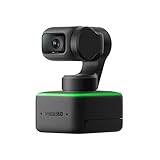
- 4K Resolution with 1/2" Sensor: Always look your best in stunning Ultra HD 4K resolution. With a best-in-class 1/2" sensor, Link captures life-like detail with an excellent dynamic range.
- AI Tracking: With a gimbal design and a powerful AI tracking algorithm, Link's lens rotates to follow your every movement. With automatic zooming and framing, you'll always be center stage.
- Gesture Control: Control the camera with 3 simple hand gestures. No clicks necessary. ✋ = Enable AI tracking | 👆 = Zoom in/out | ✌️ = Enable Whiteboard Mode.

It also carries a handful of features most competitors skip: hand gesture commands, a downward-tilting DeskView mode, whiteboard capture with recognition markers, and dual noise-canceling mics. Compatibility covers Zoom, Microsoft Teams, Google Meet, and anything else that reads a standard USB camera.
Bottom Line
For remote workers, streamers, and educators who need the camera to follow them instead of the other way around, the Link earns its premium over a standard 1080p webcam.
Check current availability and pricing for the Insta360 Link on Amazon.
Insta360 Link PTZ 4K Webcam Overview
Arashi Vision built this around hardware you normally find in action cameras: a 1/2-inch CMOS sensor, an f/1.8 lens, and optical stabilization on a motorized pan-tilt-zoom gimbal. The body measures roughly 2.48 by 1.38 by 1.77 inches and mounts on a magnetic clip that grips a laptop lid or sits on a desk.
Connection is USB-C, with a USB-A adapter included alongside four recognition markers for whiteboard framing.
| Specification | Detail |
|---|---|
| Sensor | 1/2″ CMOS, 8.3MP effective stills |
| Video | 4K/30, 1080p/60, 720p/60 |
| Aperture | f/1.8 |
| Field of view | 67° |
| Zoom | 4x digital |
| Codec | H.264 and MJPEG |
| Audio | Dual noise-canceling mics |
| Warranty | One year |
Windows 8.1 or later is required for 4K output; macOS 10.10 and up is supported.
4K Image Quality and Autofocus
Detail holds up well because the sensor is roughly four times the area of what sits inside most 1080p webcams. Skin tones stay natural under mixed lighting, and HDR mode pulls back blown-out windows behind you without crushing the shadows on your face.
The f/1.8 aperture gives you enough depth-of-field separation to pull yourself away from a cluttered background, with no software blur needed.
Phase-detection autofocus locks quickly and stays locked when you lean in or hold up an object. That responsiveness is a step above the contrast-detection systems in cameras like the Logitech Brio 500, which hunt noticeably in dim rooms.
Low light is the honest limit. Grain appears once you drop below a well-lit room, though the noise stays fine-grained rather than blotchy.
AI Tracking and Motorized Gimbal
The gimbal is what separates this from every fixed-lens competitor. Motors pan and tilt the lens to follow you as you move around a room, while the tracking algorithm auto-zooms to keep your framing consistent whether you stand up or roll back from the desk.
Movement is smooth and damped, without the jerky snap that makes motorized cameras distracting on a call.
Tracking works reliably when one person is in frame. Add a second person walking behind you and the algorithm occasionally reconsiders its subject, which is why several long-term owners turn tracking off during formal presentations.
When idle, the lens rotates down and parks itself, giving you a physical privacy shutter that no software toggle can override. Fixed webcams like the Microsoft Modern Webcam rely on a manual cover instead.
Gesture Controls and Link Controller Software
Control happens two ways: hand signals in front of the lens or a desktop app with manual sliders. Both matter because gesture recognition handles quick changes mid-call, while the software is better for setup.
Gesture Control in Everyday Calls
Three gestures cover the essentials. An open palm toggles AI tracking, a raised finger triggers zoom in or out, and a peace sign switches on Whiteboard Mode.
Recognition is fast at normal seated distance and works from across a small room. False triggers do happen if you gesture while speaking, which is the main reason to disable gestures before a client presentation.
Manual Camera Adjustments in Link Controller
The Link Controller app gives you direct control over brightness, exposure, white balance, and gimbal position. You can nudge the lens to an exact angle and save it, which is useful if your desk setup never changes.
Frame rate, resolution, and HDR are toggled here as well. The app runs on both Windows and macOS, and settings persist once applied, so you configure it once and mostly forget it.
Whiteboard, DeskView, Overhead, and Portrait Modes
Four specialized modes handle situations a static webcam simply cannot cover. Whiteboard Mode uses the four included markers to detect the board’s corners, then crops, deskews, and enhances the writing so text stays readable to remote viewers.
DeskView tilts the lens downward and applies perspective correction, turning your desk surface into a second camera angle for sketching or showing physical products.
Overhead Mode points the lens straight down for top-down demonstrations, and Portrait Mode rotates the framing to 9:16 for vertical streaming platforms.
None of these require third-party software. They switch instantly through the controller app or a gesture, which makes the Link practical for teachers and anyone reviewing physical documents on camera. Compare that to the single fixed angle of a Razer Kiyo Pro.
Dual Noise-Canceling Microphones
Audio is competent for meetings and unremarkable for content. The two mics apply noise suppression that knocks down keyboard clatter and room hum while keeping your voice forward in the mix.
Voices stay intelligible at normal desk distance, roughly two feet from the lens. Move farther back and the processing thins your tone noticeably.
For streaming or podcasting, a dedicated USB or XLR mic still outperforms this by a wide margin. If audio quality is a priority for your setup, our guide to the best microphone for podcasting covers options that pair well with the Link’s video.
Who Should Buy the Insta360 Link?
Remote workers who present, move, or teach get the most out of this camera. The tracking gimbal earns its keep the moment you leave your chair to point at something on a wall or work through a problem on a whiteboard.
Educators and trainers benefit from DeskView and Whiteboard Mode more than anyone else.
Streamers and creators who want near-camera quality without wiring up a mirrorless body will find it a reasonable middle ground, though a dedicated setup like a Sony Alpha a6400 still wins on low-light performance and lens choice.
If you sit still, take calls in a fixed spot, and never share physical materials, a good 1080p camera covers you for far less money. Our roundup of webcams includes several worth comparing.
Pros and Cons
Pros
- Large 1/2-inch sensor delivers detail and dynamic range well beyond typical webcams
- Motorized gimbal with reliable AI subject tracking and auto-zoom
- Fast phase-detection autofocus that holds under movement
- Whiteboard, DeskView, Overhead, and Portrait modes cover teaching and demo scenarios
- Lens rotates down when idle for genuine physical privacy
- Detailed manual control through Link Controller on Windows and macOS
Cons
- Priced well above mainstream 1080p webcams
- Noise becomes visible in dim rooms despite the fast f/1.8 lens
- Gesture recognition can misfire during animated speaking
- Microphones fall short of a dedicated USB or XLR option
- Tracking gets confused when multiple people enter the frame
- 4K output requires Windows 8.1 or later and a reasonably current machine
What Customers Say
Owners consistently rank the Link above the Logitech and Razer cameras they replaced, with several photographers and streamers noting that image quality and phase-detection focus close much of the gap toward a proper camera body. The gimbal draws the most praise, both for tracking and for the flexibility of placing the camera anywhere on a desk.
Buyers using it for Zoom presentations frequently mention disabling gestures and auto-follow during important calls to avoid unintended reframing.
Support experiences come up in a few longer reviews, with at least one owner upgrading their rating after a fast replacement unit resolved a hardware fault. Reviews in Spanish, Portuguese, Japanese, and French echo the same conclusion about clarity and build.
Conclusion
The Link makes sense when your video calls involve movement, physical objects, or a whiteboard. The combination of a 1/2-inch sensor, motorized tracking, and mode switching handles those situations without extra software or a capture card.
Sitting still in a well-lit room, a cheaper camera gets you 80 percent of the way there.
Set it up with Link Controller on day one, adjust exposure to match your lighting, and leave gestures disabled if you talk with your hands. That configuration gets the most out of it for daily meetings.
View the Insta360 Link on Amazon.
Frequently Asked Questions
Is the Insta360 Link worth the price?
It justifies the cost if you use the tracking gimbal or specialized modes regularly. For static desk calls in decent lighting, a mainstream 1080p camera delivers most of the visible benefit at a fraction of the outlay.
Does the Insta360 Link work with Zoom, Microsoft Teams, and Google Meet?
Yes, it registers as a standard USB camera across all three platforms, plus Skype, OBS, and browser-based conferencing. No drivers are required for basic operation, though Link Controller unlocks manual exposure and gimbal positioning.
Can the Insta360 Link follow a person automatically?
Yes, AI tracking rotates the lens to keep you framed as you move, with automatic zoom adjusting the crop. Enable it with an open-palm gesture or through the desktop app, and expect reliable results with a single subject in frame.
Does the Insta360 Link have a built-in microphone?
It includes dual noise-canceling microphones that suppress background noise and keyboard sound. Audio is clear enough for meetings at normal desk distance, though serious streaming or recording warrants a separate microphone.
Can the Insta360 Link be used for whiteboard presentations?
Yes, Whiteboard Mode uses four included corner markers to detect the board, then straightens and sharpens the image for remote viewers. A peace sign gesture activates it without touching your computer.
What is the difference between the Insta360 Link and Insta360 Link 2?
The Link 2 is the newer generation, adding a wider field of view and updated tracking behavior compared with the original reviewed here. The original still delivers 4K, gimbal tracking, and every specialized mode, and it typically sells for less while stock remains available.
TechBytes

Our mission is to showcase the complex world of technology with comprehensive, accessible reviews. We bring you the freshest insights on everything from the most streamlined smartphones to the mightiest laptops, as well as the latest in smart home gadgets that simplify your daily routine and fitness wearables that monitor your well-being. Rest assured, we're here to guide you through the ever-evolving tech landscape.
