
Scanning printed photos is still one of the easiest ways to keep memories safe and back up those irreplaceable snapshots. Sure, you could just point your phone at old prints, but a dedicated photo scanner gets you way better image quality, higher resolution, and lets you tackle big stacks without much hassle. These machines are built for photos, with features that help protect delicate prints and even restore details lost to fading or time.
Photo scanners come in all shapes and sizes—from small, single-photo gadgets for occasional use to sturdy flatbeds and sheet-fed models that chew through piles of prints or even film negatives. Which one’s right for you? That really depends on your photo collection, how picky you are about resolution, and whether you want extras like dust removal or color correction. Some models toss in software for organizing or touching up scans, while others just focus on speed and simplicity.
Before you buy, think about optical resolution, color accuracy, how it connects to your computer, and whether it’ll fit on your desk. If you have fragile or oversized photos, a flatbed’s probably the way to go. For big batches, sheet-fed models are a lifesaver. Features like auto-cropping, built-in restoration, and OS compatibility can make a surprising difference. After digging through specs and reviews, we narrowed down the scanners that really stand out for image quality, speed, and all-around usability.
Best Photo Scanners
This isn’t just a spec sheet—it’s a rundown of the top photo scanners out there right now, picked for their performance, ease of use, and how well they just get the job done.
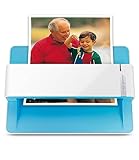
- The easiest way to scan photos and documents. Supports 3x5, 4x6, 5x7, and 8x10 in sizes photo scanning but also letter and A4 size paper. Optical Resolution is up to 600 dpi ( PS: two setting: 300dpi/ 600dpi).
- Fast and easy, 2 seconds for one 4x6 photo and 5 seconds for one 8x10 size photo@300dpi. You can easily convert about 1000 photos to digitize files in one afternoon and share with your family or friends.
- More efficient than a flatbed scanner. Just insert the photos one by one and then scan. This makes ePhoto much more efficient than a flatbed scanner.

Plustek ePhoto Z300

If you’ve got boxes of photos and want something fast and easy, this scanner is hard to beat.
Pros
- Scans each photo in just a couple of seconds
- Intuitive, simple setup and operation
- Image restoration tools help refresh faded photos
Cons
- Only supports scanning one photo at a time
- Plastic feed tray feels a bit lightweight
- Bulkier photo batches require manual sorting
Digitizing photos with the Plustek ePhoto Z300 is refreshingly painless. Setup is pretty much plug-and-play, and after that, it’s just a matter of slipping in each photo—no annoying lids or menus to deal with. The built-in restoration tools actually help with minor fixes, and the scans look impressively true to the originals.
Switching between standard and higher resolution is simple enough, and it’s nice being able to balance speed and image quality without a headache. Scanning a hundred family prints felt way quicker than any flatbed I’ve used before. The Z300 didn’t jam or misalign anything, and the deskew feature saved me from extra edits.
Even though it’s a one-at-a-time feed, there’s barely any waiting—photos zip through, and digital files show up almost instantly. If you want more nitty-gritty details, check out the Plustek Photo Scanner ePhoto Z300 Review: Best 4×6 Scanner?. For anyone tired of clunky, old-school scanning, this thing is a serious time-saver.

- Scanner type: Document
- Connectivity technology: USB
- With Auto Scan Mode, the scanner automatically detects what you're scanning
Canon Canoscan Lide 300 Scanner
If you want something compact and straightforward for both photos and documents, this one’s worth a look.
Pros
- Slim, space-saving design fits small desks easily
- Quick, straightforward setup with minimal fuss
- Accurate color reproduction when scanning older photos
Cons
- Limited to scanning up to A4 size
- Basic bundled software can feel clunky
- No wireless or network functionality
It’s surprisingly fast—about 10 seconds per scan—and the results are crisp, with colors that pop more than expected. Tried it on a stack of old family prints, and honestly, the detail was better than I’d hoped. The small footprint is a real bonus if you’re short on space.
The four physical buttons make life easier for quick scans or copies. Auto-scan mode is smarter than you’d think, picking up whether it’s a photo or doc and adjusting settings on its own. If you switch between scanning photos and paperwork, that’s a time-saver.
Setup is almost plug-and-play, but if you need to scan anything bigger than A4 or want advanced features, you might feel boxed in. The software could use a refresh, especially for big projects. For more hands-on impressions, there’s a detailed review with real-world feedback.

- MANAGE HOME AND SMALL BUSINESS DOCUMENTS WITH EASE. Large color touchscreen; fast 40ppm duplex scanning; Wi-Fi and USB connectivity; photo scanning; and support for a wide variety of cloud services
- DOCUMENT MANAGEMENT AT YOUR COMMAND. Easily select your scanning destination with up to 30 scanning profiles. Send to PC, Mac, Chromebook, mobile devices and cloud services
- GREAT FOR YOU, GREAT FOR A TEAM. Users can select their profile from the touchscreen and access their personal shortcuts and destinations
ScanSnap iX1600 Photo Scanner
If you’re looking for a scanner that chews through photos and paperwork without drama, the ScanSnap iX1600 is worth considering.
Pros
- Scans photos and documents quickly with little setup.
- Offers wireless options for maximum placement flexibility.
- Intuitive touchscreen and profiles simplify repeated tasks.
Cons
- Included software lacks in-depth PDF editing tools.
- Power adapter may not match your region out of the box.
- Bulkier than flatbed-only alternatives.
Getting the ScanSnap iX1600 up and running is refreshingly clear-cut, and you don’t need to be a tech wizard to figure out the touchscreen or ScanSnap Home software. Wireless connectivity is a real perk—being able to park it somewhere out of the way keeps your desk clear. Scanning stacks of family photos or receipts quickly becomes routine, and I didn’t run into any jams.
Switching between different scan jobs is easy, especially if you set up custom profiles. After using it daily for a while, I can say it handles a steady workload without a hiccup. Image quality is consistently sharp and true, so you won’t end up rescanning things over and over.
If you’re hoping for deep editing features, you might be a bit let down by the included software, and it does take up more desk space than a small flatbed. For more on how it handles both home and office tasks, the in-depth review of ScanSnap iX1600 digs into the details. All in all, it’s a solid pick for mixed scanning needs.

- CLEAR, DETAILED PHOTO SCANS – Achieve amazing image clarity and detail with a 4800 dpi optical resolution, perfect for enlarging photos.
- IMAGE AND DOCUMENT SCANNER – Easily scan photos, artwork, illustrations, books, documents, and more with this compact and lightweight scanner.
- ENHANCED SCANNING – Seamlessly stitch oversized images together or cloud storage with Epson ScanSmart, maximizing efficiency.
Epson Perfection V39 II Scanner
This scanner is a smart pick for anyone who needs reliable photo digitizing at home without taking up much space.
Pros
- Reliable, detailed scans with solid image clarity
- User-friendly design suited for everyday tasks
- Handy photo restoration boosts faded colors
Cons
- Software setup can be tricky for some
- Scanning thicker items like books may be awkward
- Depends on USB power; no power adapter included
Setup for the Epson Perfection V39 II is mostly painless, and once you’re plugged in, it feels built for speed. The one-touch buttons are a real help for repetitive scanning—great when you’re slogging through a pile of photos or paperwork. Scans come out sharp, and it picks up more detail than you might expect at this price.
The Easy Photo Fix feature is no gimmick—washed-out old photos come back to life after a quick scan. Cloud integration with ScanSmart is handy for organizing, though actually downloading and installing the software took a bit more effort than I’d like. There’s more on the scanner’s practical features in the Epson Perfection V39 II Scanner Review: Best Budget Flatbed?.
The compact design is a real plus—it tucks next to a laptop or slides onto a shelf easily. It’s light, so moving it around isn’t a hassle. Scanning thick books or albums can be a pain, and relying on USB power alone might not work for everyone. Still, for a home archive project, it’s a practical, space-saving pick.

- World’s Fastest Personal Photo Scanner (1) — scan thousands of photos as fast as 1 photo per second at 300 dpi (2); batch-scan up to 36 photos at a time
- Preserve Your Priceless Photos — restore, organize, protect and share photos; scan Polaroid photos, panoramas, postcards and photos up to 8" x 10"
- Share Stories for Future Generations — use the Epson FastFoto app (3) to add voice and text over your photos or create slideshows, right from your smartphone
Epson FastFoto FF-680W
If you’re hoping to blast through a big photo collection without getting bogged down, the Epson FastFoto FF-680W is honestly tough to beat. It’s built for speed and can really take the hassle out of archiving old prints.
Pros
- Batch scanning makes archiving old photo albums fast and easy
- Intuitive mobile app for sharing and organizing photos
- Automatic color restoration noticeably improves faded prints
Cons
- Higher price point than basic models
- Wireless setup can be a bit time-consuming
- Occasionally, delicate or curled photos may require extra care
Getting the Epson FastFoto FF-680W up and running isn’t hard, but the Wi-Fi setup does take a couple of extra minutes. Once that’s sorted, the bulk feeder chews through stacks of photos with barely any fuss, and the scanning speed is honestly impressive—it’s a huge time-saver compared to a flatbed.
The auto enhancement and color restoration tools are pretty handy, especially for old snapshots that have seen better days. The included app isn’t bad either—organizing, adding voice notes, or throwing together a quick slideshow to share with family is all pretty straightforward.
Curled or extra-fragile photos sometimes need a gentler touch and a single-feed approach, which can slow things down a bit. If you’ve got a mountain of prints and want decent image quality without spending ages hunched over a scanner, this model is worth a closer look. For more nitty-gritty details, this in-depth review digs into the day-to-day quirks and perks.
Buying Guide
Picking a photo scanner isn’t just about specs—it depends on what you actually want to do. Is it boxes of family photos, or are you just after a few super-high-quality images? The size and state of your collection should guide what matters most.
Resolution is a biggie. For most snapshots, 300–600 dpi is fine, but if you’re planning to blow things up or archive forever, higher is better.
Scanner type makes a difference. Flatbeds are gentle and versatile, but if you’re on a mission to scan hundreds of prints, a sheet-fed model is so much faster. Just keep in mind, those aren’t always the best for fragile or oddly-shaped photos.
It’s helpful if your scanner can handle a mix of formats:
- Standard prints (4×6, 5×7)
- Slides and negatives
- Larger photos or documents
Key Features to Evaluate
| Feature | What to Look For |
|---|---|
| Optical Resolution | 300–1200 dpi for most needs |
| Connectivity | USB, Wi-Fi, or SD card support |
| Scan Speed | Faster speeds for large collections |
| Software | Usability, editing options, file format support |
| Size & Portability | Appropriate for workspace and storage |
Color depth and bit depth matter for getting those colors right. More bits, better color—simple as that. You’ll want at least 24-bit color for most projects.
Good bundled software can save you a lot of headaches. If you’re batch scanning or want to do quick touch-ups, look for software that’s not a nightmare to use. Dust removal and auto-cropping are nice-to-haves, too, if you can get them.
Frequently Asked Questions
Choosing a photo scanner really comes down to what you care about most—image quality, speed, or maybe some specific feature like a feeder or high DPI. Top models and apps all have their quirks, and the pros tend to focus on color accuracy and reliable print quality above all.
What features should I look for in a photo scanner for preserving old photographs?
Look for high optical resolution (at least 2400 DPI), 48-bit color depth or higher, and a flatbed design if you want to avoid damaging fragile prints.
It’s worth checking for dust and scratch removal, and make sure it can scan various paper sizes.
Photo restoration software bundled in can help bring faded or damaged shots back to life.
Which photo scanner models offer the fastest scanning speeds without compromising image quality?
Sheet-fed scanners like the Epson FastFoto FF-680W and Canon imageFORMULA RS40 are speedy and keep details sharp.
Flatbeds are slower, but models like the Epson Perfection V600 do a solid job of balancing quality and speed.
Always check the manufacturer’s listed scan speeds at your preferred resolution—sometimes marketing claims can be a little optimistic.
How do different photo scanner apps compare in terms of accuracy and color reproduction?
Apps from big hardware brands usually nail color and accuracy better than generic mobile apps.
Epson ScanSmart and Canon CaptureOnTouch tend to get good reviews for consistency.
Third-party apps are okay for quick jobs, but if your photos are faded or discolored, they usually lack advanced correction tools.
What are the advantages of using a feeder in a photo scanner for bulk scanning?
Feeders let you load up a stack and walk away, which is a lifesaver for big projects.
They’re a huge productivity boost if you’re digitizing lots of prints.
Some can handle mixed photo sizes and use guides to cut down on jams, though results can vary.
What do professional photographers recommend when choosing a scanner for high-quality prints?
Most pros stick with true optical resolutions of at least 3200 DPI and want Adobe RGB color space support.
Infrared dust and scratch removal, plus calibrated color profiles, are top priorities.
Epson and Canon models with film scanning options are popular for their flexibility.
Which photo scanners have been rated highest by industry experts for the year 2025?
The Epson Perfection V850 Pro and Canon CanoScan 9000F Mark II are still top picks when it comes to print quality and detail.
Epson’s FastFoto FF-680W gets a lot of love for its speed and how easily it handles big batches.
According to places like PCMag and TechRadar, scan accuracy and color reproduction really stand out as strong points.
TechBytes
Our mission is to showcase the complex world of technology with comprehensive, accessible reviews. We bring you the freshest insights on everything from the most streamlined smartphones to the mightiest laptops, as well as the latest in smart home gadgets that simplify your daily routine and fitness wearables that monitor your well-being. Rest assured, we're here to guide you through the ever-evolving tech landscape.
